Tesla Window Tint in Parker, CO: Model 3, Y, S, X and Cybertruck
Non-metallic Nano Ceramic film for the Model 3, Model Y, Model S, Model X and Cybertruck, installed in-shop at Polar Tint Parker on Progress Ln. It is designed not to interfere with cell signal, GPS or keyless entry, rejects up to 98% of infrared heat and stays inside Colorado's tint rules.
Parker, CO 80134 (720) 954-2853

Why should a Tesla only get non-metallic tint?
Your Tesla talks to the outside world constantly. The phone in your pocket unlocks it, the cellular link carries navigation and over-the-air updates, and GPS keeps the map honest on the drive from Parker up I-25. Older metallized films get their heat rejection from a thin metal layer, and that metal is exactly what blocks radio signals. Polar Tint Parker doesn’t put metallized film on any car that comes into 10232 Progress Ln, and it doesn’t install dyed film either.
The ceramic film we use keeps metal out of the stack. Its non-conductive ceramic particles stop infrared heat at the glass, and all three tiers are designed not to block radio frequency, so they are designed not to interfere with:
- Phone-as-key and keyless entry
- Cell service, GPS and navigation
- Toll transponders and garage door remotes
- The tire-pressure sensors
Teslas aren’t a special case here. Every EV booked into the Parker bay gets non-metallic Nano Ceramic, nothing else.
What does each Tesla model need from a tint install?
The side windows and rear glass on any current Tesla can take whichever tier you pick, in a shade that passes Colorado’s 27% rule. The real differences sit in the large glass: the curved back windows, the panoramic roofs and the Model X windshield.
| Model | Glass worth knowing about | How Polar Tint handles it |
|---|---|---|
| Model 3 | Side glass plus a single big rear window curved in two directions | We heat-shrink the film to that curve on the outside of the glass, then lay it inside in one unbroken piece, so there are no seams or relief cuts |
| Model Y | The same layout: side glass and one large compound-curve back window | The same single-piece, heat-formed rear plus full side coverage; one of the cars we see most from I-25 commuters |
| Model S | Lots of glass, with panoramic roof options | A high-IR tier pays off most on a car with this much glass |
| Model X | Lots of glass, panoramic roof options and the panoramic windshield | High-IR film on the sides and rear; on the windshield, Colorado allows only a strip on the top 4 inches |
| Cybertruck | Glass shaped unlike any other Tesla | Film is pre-formed before it goes on, for a finish with no seams |
Plenty of EVs leave the factory with treated glass, and the film has to suit that glass rather than fight it. That is part of why only Nano Ceramic goes on a Tesla at the Parker shop, and why a glass roof is always looked at with you in person before any film is cut.
How much heat will ceramic film keep out of a Tesla?
It comes down to the tier. Each of the three is non-metallic Nano Ceramic, each blocks 99% of UV, and each carries the Polar Tint Promise. The thing that changes is infrared rejection. How dark the film looks (VLT) is a separate choice you make afterward.
| Tier | IR rejection | UV rejection | VLT options |
|---|---|---|---|
| Premium Ceramic (Good) | Up to 70% | 99% | 5%, 15%, 35%, 50% |
| Ceramic Plus (Better) | Up to 90% | 99% | 5%, 15%, 35%, 50%, 70% |
| Ceramic Ultimate Plus (Best) | Up to 98% | 99% | 5%, 15%, 35%, 50%, 70% |
On a Colorado-registered Tesla, the 5% and 15% shades are only an option behind the driver, and only when the windshield and front side windows let in at least 70% (C.R.S. 42-4-227). On a normally tinted car, every window has to measure at least 27% with the film and factory glass combined, so your installer meters the glass and picks the darkest shade that passes.
Parker sits at roughly 5,800 feet, where UV and the heat load on your glass run higher than at sea level, and a Tesla parked all day in a RidgeGate or Park Meadows lot soaks up that sun for hours. That is why EV owners here most often choose Ceramic Ultimate Plus, with Ceramic Plus as the step below. The top tier matters most on a glass roof, a big back window or a car that lives outside. Every tier is compared side by side on the Parker ceramic window tint page.
A note on the numbers: “up to 98% IR rejection” refers only to the infrared part of sunlight, about 53% of the sun’s energy, not 98% of all heat. The figure that counts everything is TSER (Total Solar Energy Rejected). It is normally lower than the IR number, and we can give you the TSER for your exact tier and shade at the free estimate.
Does tint add range to a Tesla?
We won’t quote you a mileage gain. On an EV the air conditioning runs off the same battery that drives the wheels, so less solar heat in the cabin means less cooling work: the seats and wheel are cooler when you get in, and the climate system has less heat to remove on the way home. How much that shows up as range depends on speed, terrain, temperature, preconditioning and how long the car sat in the sun.
The parts we can put in writing are on the spec sheet: up to 98% infrared rejection on Ceramic Ultimate Plus and 99% UV blocked on all three tiers, which also helps keep a Tesla’s seats and screen out of the worst of the altitude sun.
What are Colorado’s tint limits for a Tesla?
An EV gets no special treatment under Colorado’s tint statute. A Model Y follows the same numbers as a pickup:
- Front side windows: 27% VLT or lighter.
- Back side windows and rear glass: also 27% or lighter, unless both the windshield and the front side windows let through at least 70% of light; only then can the glass behind the driver go darker.
- Windshield: a non-reflective strip no deeper than 4 inches from the top, never red or amber, with the windshield as a whole still at 70% light transmission or more. The Model X panoramic windshield is held to the same rule. Colorado measures the strip as a fixed 4 inches, not to the AS-1 line some other states use.
Colorado offers no medical exemption, so the 27% limit applies to every driver. Before and after the install, Polar Tint Parker checks each window with a light meter, and on the windshield we apply only the legal top strip and keep film off the camera arrays and sensor housings. Read the Colorado window tint law guide, the 4-inch windshield strip explainer or Polar Tint’s Colorado tint law page for the full rules.
Can Polar Tint Parker tint a Rivian or an F-150 Lightning?
Yes, with the same metal-free film. The Rivian R1T and R1S and the Ford F-150 Lightning all come through the Progress Ln bay, and each brings its own big rear panels and steeply raked back glass. How we shape film for those trucks is covered in the Parker guide to Tesla and EV window tint.
Should a new Tesla also get PPF or a ceramic coating?
Tint looks after the cabin. The paint faces Front Range road gravel and winter de-icer, so many new EV owners pair tint with one or both of these:
- Paint protection film: self-healing film from Partial Front up to Full Vehicle, aimed at rock chips off I-25, I-70 and E-470 and the gravel that comes with winter roads.
- Ceramic coating: 3M ceramic coating in standard and premium tiers, a hydrophobic layer that lets de-icer residue rinse off more easily.
Wondering about the order? Our ceramic coating vs PPF guide for Parker lays out which goes first.
What happens when you bring a Tesla to Polar Tint Parker?
- Get a free estimate. Call (720) 954-2853, message the shop or drive over to 10232 Progress Ln in Parker. Doors are open 8am to 5pm, seven days a week.
- Choose tier, shade and coverage. Your installer looks over the car with you, settles the tier, shade and which glass gets film, and shows where Colorado’s limits fall. The written quote lists the tier, coverage, install date and warranty terms.
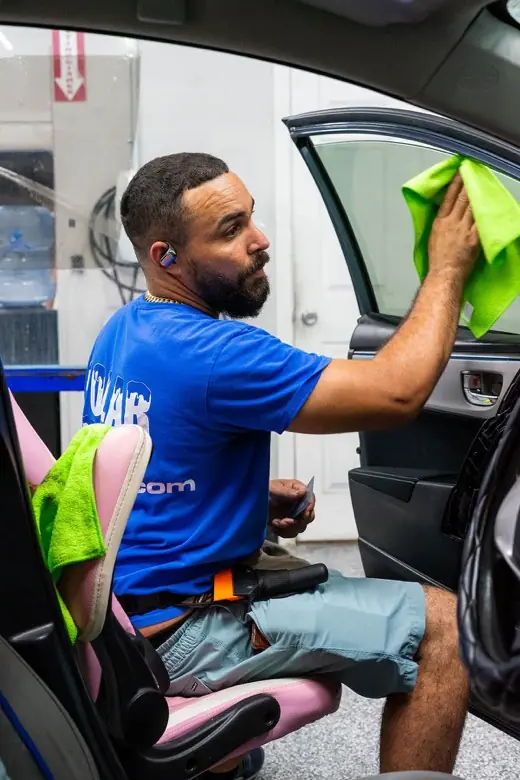
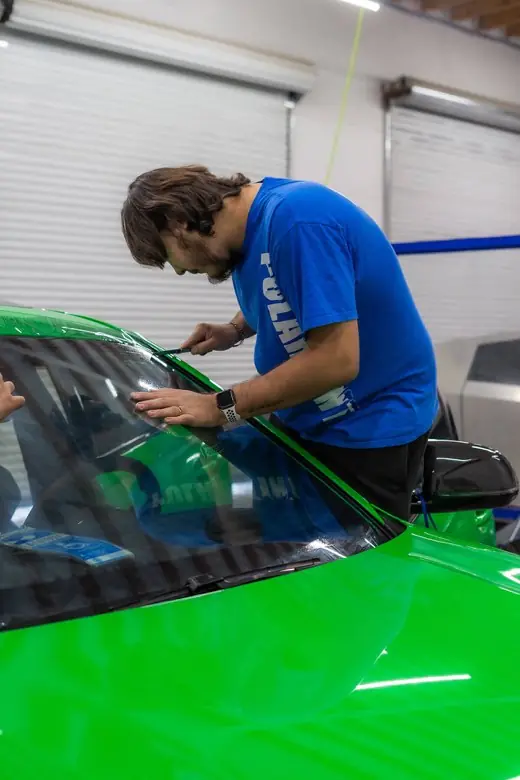
- Install inside a climate-controlled bay. Every car is tinted indoors, never outside, so dust on a dry summer afternoon or a February cold snap stays out of the job. Shop time depends on how much glass the model has, whether the roof is included and how curved the pieces are; your installer confirms it on the quote.
- Leave the windows up while it cures. Plan on 3 to 5 days in warm weather and 5 to 7 days on cold Front Range days. Driving right away is fine.
Tesla owners come to the Parker shop from Castle Rock, Lone Tree, Highlands Ranch, Centennial, Aurora South, Castle Pines and across the southeast Denver Metro.
Polar Tint Parker is an independent tint shop with no affiliation with Tesla, Inc., and Tesla has not authorized or endorsed it. Tesla, Model 3, Model Y, Model S, Model X and Cybertruck are trademarks of Tesla, Inc.
Quick answer — what tint should go on a Tesla in Parker, CO?
Non-metallic Nano Ceramic film, installed at 10232 Progress Ln in one of three tiers: Premium Ceramic rejects up to 70% of infrared heat, Ceramic Plus up to 90% and Ceramic Ultimate Plus up to 98%, the tier Parker EV owners pick most. Each one blocks 99% of UV and is designed not to interfere with phone-as-key, cell service or GPS.
In Colorado every side window and the rear glass must stay at 27% VLT or lighter; the glass behind the driver can go darker only if the windshield and front side windows both pass at least 70%. Tesla tint is quoted locally at a free estimate and covered by the Polar Tint Promise. Other cars and trucks are covered in our full window tint guide.
Parker Tesla tint questions, answered
Will ceramic film affect my Tesla’s phone key or connectivity?
What is the darkest legal tint for a Tesla in Colorado?
Can Polar Tint Parker film a Tesla glass roof?
Is tint allowed on the Model X windshield in Colorado?
Which ceramic tier do Parker Tesla owners choose?
Is Polar Tint Parker a Tesla-approved installer?
How much does it cost to tint a Tesla in Parker?
Where is Tesla window tint done in Parker, CO?
Get a Tesla window tint quote.
Fill in the form, message the shop or call (720) 954-2853.
Ready to tint your Tesla?
Bring the car to 10232 Progress Ln, call (720) 954-2853 or ask for a quote online.