Premium Ceramic Window Tint

Window Tint. Cooler cabin. Cleaner glass. Color that lasts.

Premium ceramic window tint for cars, trucks, and SUVs in three IR-engineered grades — Premium Ceramic up to 70% IR, Ceramic Plus 90% IR, and Ceramic Ultimate Plus 98% IR. 99% UV protection on every tier. Non-metallic, designed not to interfere with phone, GPS or keyless signals, built to resist purple fade. Backed by the Polar Tint Promise.

  • Polar Tint Promise
  • Polar Tint Match Guarantee
  • Polar Tint Certified Installers
  • Non-metallic — designed not to interfere with phone, GPS or keyless signals

Quick answer — what is premium ceramic window tint?

Premium ceramic window tint uses non-metallic nano-ceramic particles to reject infrared heat and UV at the glass — without changing color or fading purple — and is designed not to interfere with cellular, GPS, or toll transponder signals. Polar Tint installs three IR-engineered grades: Premium Ceramic (up to 70% IR) for everyday daily-driver comfort, Ceramic Plus (90% IR) for hot-climate cabin cooling, and Ceramic Ultimate Plus (98% IR) for the biggest cabin temperature drop in our lineup. Every grade blocks 99% of UV and is covered by the Polar Tint Promise. Free quote at any Polar Tint Certified location.

Three Ceramic Grades · At-a-Glance

Compare the three Nano Ceramic tiers.

Every Polar Tint shop carries the same three Nano Ceramic grades. Same Polar Tint Promise on all three. The right pick depends on how hot it gets, how much heat you want rejected, and how dark you want to go.

Premium Ceramic (Good)

Reliable Nano Ceramic protection. Available in 5%, 15%, 35%, 50% VLT.

UV Protection
99%
Heat Rejection
Up to 70% IR
Installer
Polar Tint Certified
Warranty
Polar Tint Promise

Ceramic Plus (Better)

Enhanced heat rejection across five VLT options. 5%, 15%, 35%, 50%, 70% VLT.

UV Protection
99%
Heat Rejection
Up to 90% IR
Installer
Polar Tint Certified
Warranty
Polar Tint Promise
Why ceramic window tint

Six measurable wins.

Cooler cabin

Cuts IR heat at the glass so seats, steering wheel, and dash stay drivable in summer. The AC doesn’t have to fight the sun as hard.

99% UV defense

Every Polar Tint ceramic tier blocks 99% of UV — what fades dashes, cracks leather, and bleaches upholstery.

Glare reduction

Crisp visibility at sunrise and sunset. Less squinting on the freeway, less eye fatigue on long drives.

Designed not to interfere with signals

Non-metallic ceramic, designed not to interfere with cellular, GPS, satellite radio, garage openers, toll transponders, or TPMS.

No purple fade

Cheap dyed film turns purple as the dye breaks down. Ceramic uses nano-particles, not pigment — it’s color-stable. We stand behind your window film and our installation work with the Polar Tint Promise. The film also carries the manufacturer’s lifetime warranty for the life of the vehicle.

Polar Tint Promise

We stand behind your window film and our installation work with the Polar Tint Promise, honored at any Polar Tint location. The film also carries the manufacturer’s lifetime warranty for the life of the vehicle.

Three IR-engineered tint grades

Pick the ceramic window tint for the heat you actually drive in.

Every Polar Tint Certified location installs all three grades of Nano Ceramic automotive window tint. The right pick depends on your climate, your daily-driver use, and how much cabin temperature you want to lose at a stoplight in August. Talk to your installer — samples ride in the car so you see the look on your glass before any film is cut.
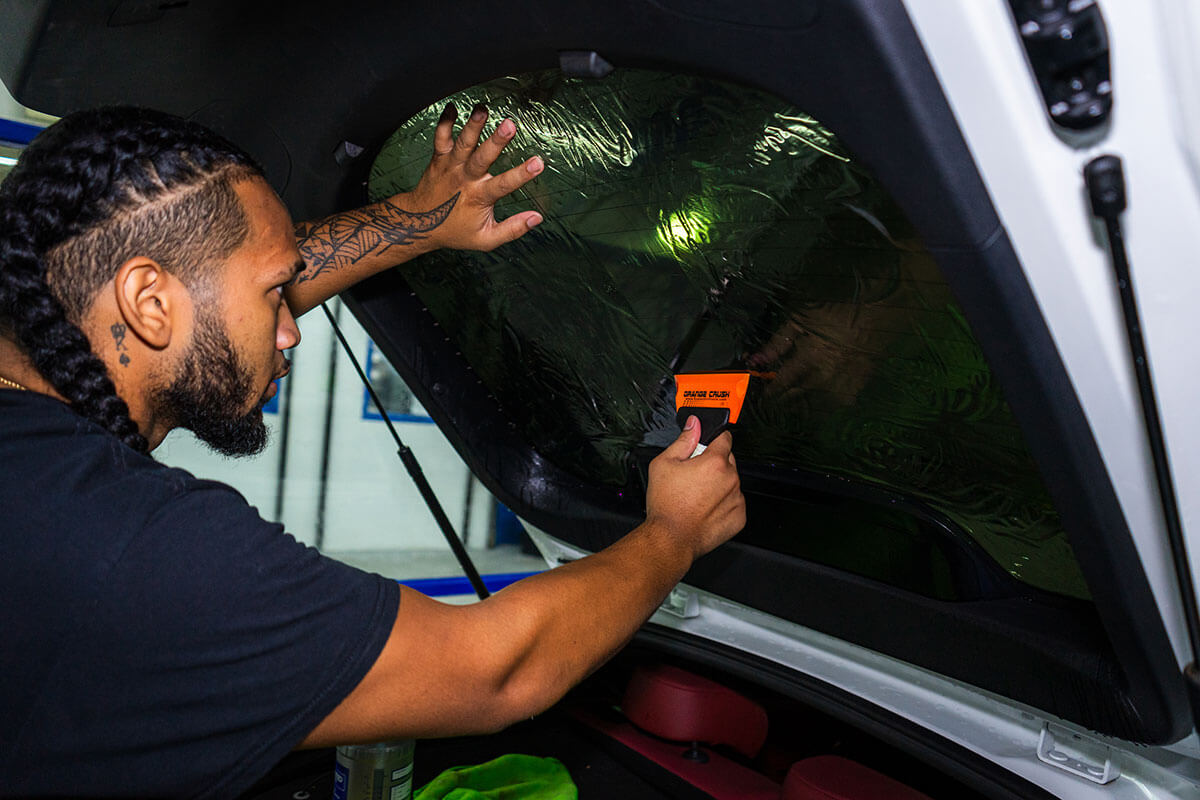
Premium ceramic window tint applied to a sedan rear window during a Polar Tint Certified install
Premium Ceramic · up to 70% IR daily-driver grade
Good — entry ceramic

Premium Ceramic — up to 70% IR, 99% UV.

Premium Ceramic is the Polar Tint daily-driver tier. Real nano-ceramic film, real non-metallic chemistry, real 99% UV rejection — designed not to interfere with signals the way metallic film can, and without the dyed-film purple fade. For most cars in most climates, this is the grade that delivers visible cooling, full UV defense, and a color-stable finished look. We stand behind your window film and our installation work with the Polar Tint Promise. The film also carries the manufacturer’s lifetime warranty for the life of the vehicle. It is the most-installed tier on the Polar Tint network because it solves the loudest problems (sun on the dash, glare on the freeway, hot leather seats) without overspending on IR you would not feel.

Premium Ceramic is fully non-metallic, so it is designed not to interfere with cellular signals, GPS, satellite radio, garage openers, toll transponders, or tire-pressure sensors. It is available in 5%, 15%, 35%, and 50% VLT — from a deep 5% privacy shade to its lightest shade, 50 (51% measured VLT, up to 49% IR) — on cars, trucks, SUVs, and vans. The near-clear 70 shade comes in Ceramic Plus and Ceramic Ultimate Plus. Every Premium Ceramic install carries the Polar Tint Promise on film, install, and adhesive.

  • Up to 70% infrared (IR) heat rejection at the glass
  • 99% UV protection — helps protect dash, leather, fabric, skin
  • Non-metallic — designed not to interfere with phone, GPS or keyless signals
  • Color-stable — built not to purple, bubble, or fade
  • Every legal VLT available for your state
  • Polar Tint Promise on film, install, and adhesive
Where Premium Ceramic shines Daily drivers · mild and temperate climates · leased vehicles · commuter sedans and SUVs · cars that already have factory-tinted rear glass and just need the front three matched up · budget-aware buyers who still want real ceramic, not dyed.
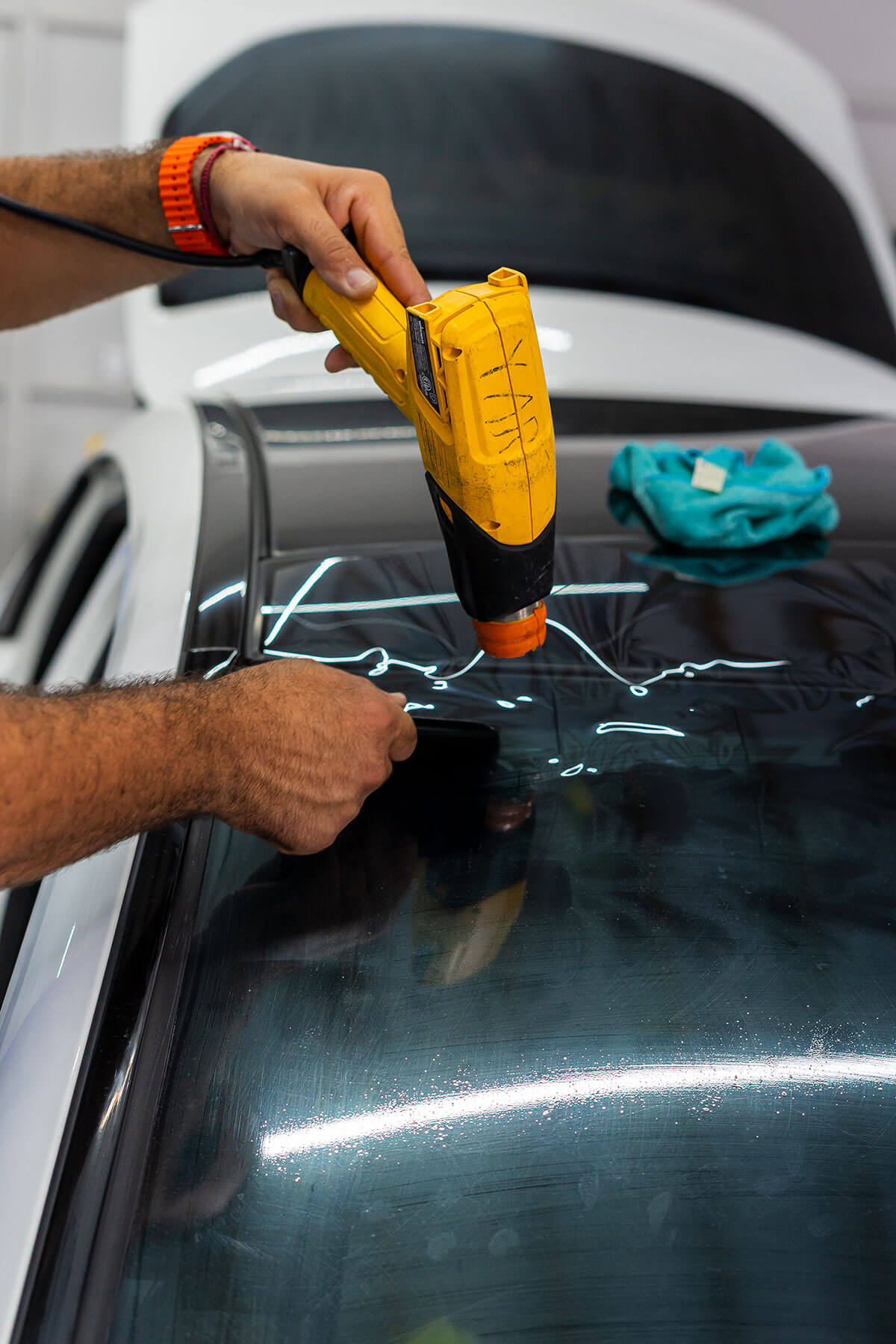
Ceramic Plus 90% IR window tint installed on an SUV during a Polar Tint Certified bay session
Ceramic Plus · 90% IR hot-climate grade
Better — hot-climate grade

Ceramic Plus — 90% IR, 99% UV.

Ceramic Plus is the step up most hot-climate drivers actually feel. The IR rejection jumps from 70% to 90% — meaning the heat that used to bake the cabin during a desert summer afternoon largely never makes it through the glass. Steering wheels you can grip without flinching. Leather seats that stop searing your back through a t-shirt. AC that hits set temperature in a few blocks instead of a few miles. For drivers in the desert Southwest, the Gulf Coast, Florida, central Texas, and high-UV high-elevation regions, this is the grade the math works out on.

Like every Polar Tint ceramic tier, Ceramic Plus is fully non-metallic and designed not to interfere with cellular, GPS, toll transponder, or tire-pressure sensor signals. The film also blocks 99% of UV, which can help the interior age more slowly than behind uncoated glass. Available in every legal VLT for your state.
  • 90% infrared (IR) heat rejection at the glass
  • 99% UV protection across all VLT options
  • Helps keep the cabin cooler in desert and Gulf climates
  • Non-metallic — designed not to interfere with signals, transponders, or sensors
  • Color-stable — built not to purple, fade, or bubble
  • Polar Tint Promise on film, install, and adhesive
Where Ceramic Plus shines Desert Southwest · Florida and the Gulf Coast · central and south Texas · California Central Valley · high-altitude UV-heavy regions · leased luxury vehicles with leather interiors · rideshare drivers on the road all day.
Ceramic Ultimate Plus 98% IR window tint installed on a luxury vehicle during a Polar Tint Certified bay session
Ceramic Ultimate Plus · 98% IR maximum cabin cooling
Best — maximum heat rejection

Ceramic Ultimate Plus — 98% IR, 99% UV.

Ceramic Ultimate Plus is the maximum ceramic window tint on the Polar Tint network. 98% infrared rejection at the glass means the IR heat that would normally turn a cabin into an oven on a 110°F afternoon is almost entirely stopped before it enters. This is the grade that wins back actual road usability for drivers in the worst summer markets — Phoenix, Las Vegas, Houston, Dallas, Miami, Tampa, Orlando, the Inland Empire, the Coachella Valley, and the entire Gulf in July. It is also the grade that helps protect high-end leather interiors, because it blocks most of the heat that ages those materials.

Ceramic Ultimate Plus stays fully non-metallic and is designed not to interfere with phone, GPS, keyless, transponder or TPMS signals. The film is color-stable and resists the bubbling, fading, and edge-lifting that kill cheap film. Available in every legal VLT for your state, on cars, trucks, SUVs, and vans. Every install is backed by the Polar Tint Promise.
  • 98% infrared (IR) heat rejection — maximum on the network
  • 99% UV protection across all VLT options
  • Cabin temperature drop you can feel within minutes of getting in the car
  • Premium non-metallic ceramic chemistry — designed not to interfere with phone, GPS or keyless signals
  • Color-stable — resists purpling, bubbling, and edge lift
  • Polar Tint Promise on film, install, and adhesive
Where Ceramic Ultimate Plus shines Phoenix · Las Vegas · Houston · Dallas-Fort Worth · Miami · Tampa · Orlando · Inland Empire · high-end leather interiors · black-and-dark-paint vehicles · rideshare and delivery drivers running 8+ hours a day in summer · vehicles parked outdoors with no shade.
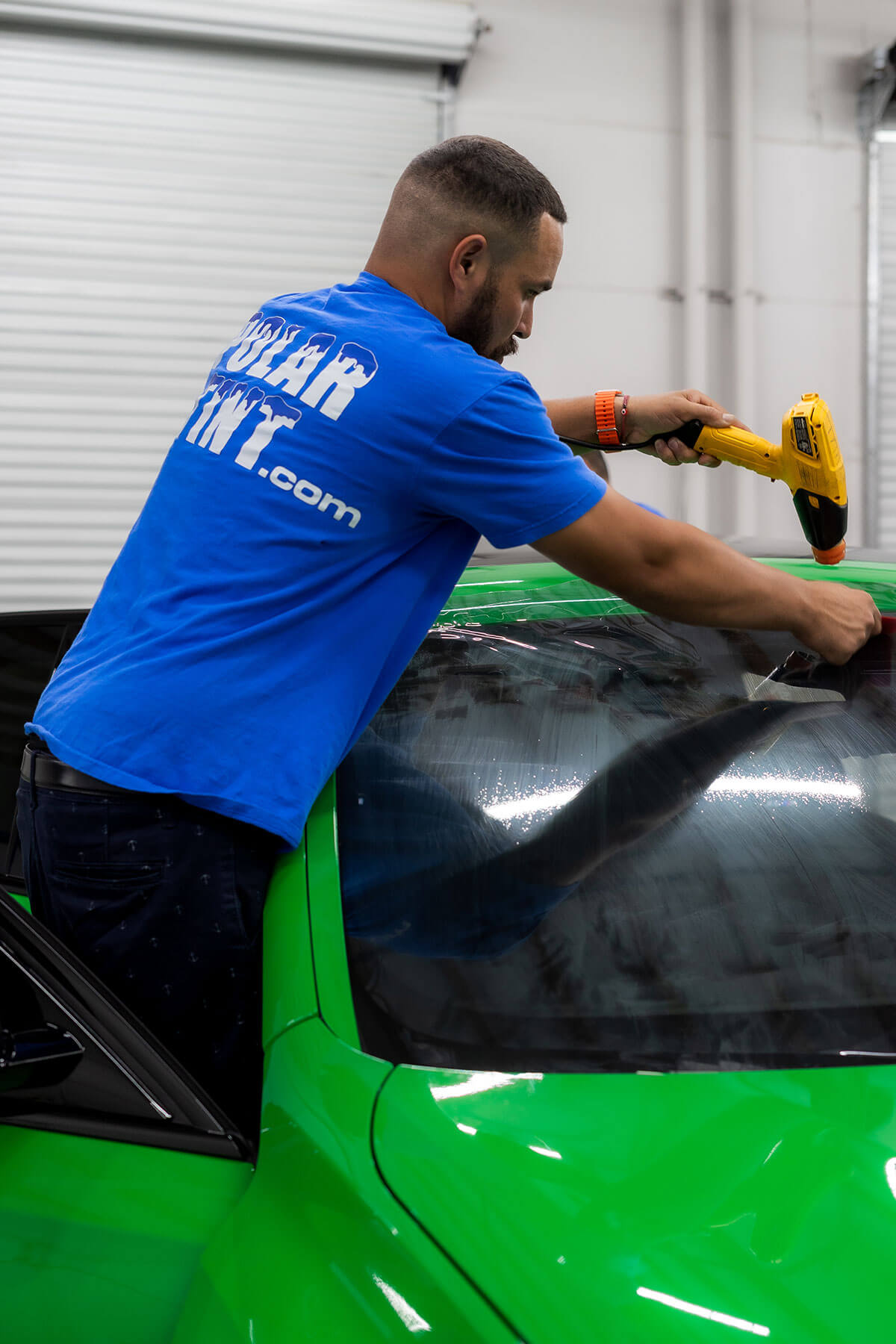
Polar Tint certified installer heat-shrinking nano ceramic window tint film on a vehicle windshield — branded shop tee, in-bay install
Ceramic over dyed · the long-term math

Why ceramic over dyed or carbon film.

Dyed window tint blocks light through pigment alone. It is cheap, but the pigment breaks down under UV — which is the exact thing tint is supposed to defend against. Over time dyed film starts to fade, bubble at the edges, and turn purple, and eventually it has to come off and go on again. Polar Tint does not install dyed film because of how it ages: fading, bubbling, and purpling.

Already seeing bubbles on tint you have now? See our guide to window tint bubbling to tell normal cure-period haze from a real warranty issue.

Carbon tint is a middle tier — it lasts longer than dyed and doesn’t purple, but its IR heat rejection is meaningfully lower than ceramic, and the gloss can read slightly flat. Metallized film blocks heat well but uses actual metal in the construction — which interferes with cellular signals, GPS, satellite radio, garage door openers, and toll transponders. That is a deal-breaker for any modern vehicle that depends on those signals.

Premium ceramic window tint is the answer to all three problems. Nano-ceramic particles physically reject IR heat and UV without changing color, and the film is designed not to interfere with phone, GPS, or keyless signals. It is the film Polar Tint installs exclusively, and every install is backed by the Polar Tint Promise.

  • Ceramic is built not to purple — the pigment-free chemistry has no dye to fade
  • Non-metallic — safe for cellular, GPS, transponders, and TPMS
  • True IR heat rejection — far higher than dyed or carbon
  • Optically clear — the through-view is crisp at every legal VLT
  • Polar Tint Promise — on the window film and the installation
The Polar Tint rule Real ceramic, real Polar Tint Promise, real non-metallic chemistry, real Match Guarantee. If a shop is quoting cheaper, ask whether the film is actually ceramic — or just labeled ceramic. The Polar Tint Match Guarantee handles legitimate quotes for the same product.
Why Polar Tint

The trust signals that come with every install.

  • Polar Tint Certified Installer Network

    Every Polar Tint location is staffed by Polar Tint Certified technicians trained on the same install protocol, the same bay setup, and the same warranty discipline. Same standard in Phoenix as in Miami as in Las Vegas.

  • Polar Tint Promise

    We stand behind your window film and our installation work with the Polar Tint Promise. The Promise follows you to any Polar Tint Certified location nationwide. The film also carries the manufacturer’s lifetime warranty for the life of the vehicle.

  • Polar Tint Match Guarantee

    Bring a written quote from any licensed competitor on the same film and same coverage. Polar Tint matches the price and still includes the Polar Tint Promise. Match honored across the certified network.

  • Local shop, network-wide standard

    Every Polar Tint is a local shop, locally accountable — with the Polar Tint network behind it for film supply, install protocol, and warranty continuity. You get a real local shop, not a faceless chain.

Free, no-obligation quote

Three steps from quote to finished install.

Polar Tint quotes every automotive ceramic tint job in person. Your installer walks the vehicle, confirms VLT against state law, and gives you a written number before any film is cut.

  1. 1

    Schedule the visit.

    Find your nearest Polar Tint Certified location and book a free walk-around at a time that works for you. No deposit, no pressure.

  2. 2

    We inspect the vehicle on-site.

    A Polar Tint Certified installer walks the car, recommends the right ceramic grade for your climate and use, and confirms legal VLT for your state on every window.

  3. 3

    Written quote, your timeline.

    You get a full written quote, scope, install date, and warranty terms. You decide. The Polar Tint Promise applies to whatever ceramic grade you choose.

Heat science

IR vs UV vs TSER: how to actually read a heat-rejection number

The short version: a high "IR rejection" number is good, but it only describes part of the sun's energy — not all the heat. To compare films honestly you need three terms, and one of them, TSER, is the one most ads quietly leave out.

Sunlight hitting your car splits into roughly 53% infrared (IR, the radiant heat you feel on your arm), 44% visible light, and 3% ultraviolet (UV). VLT just describes how dark the film looks. UV rejection is the share of ultraviolet blocked — every Polar Tint grade stops 99% of UV, protecting skin and interiors. IR rejection is the share of infrared blocked at the measured wavelengths: up to 70% on Premium Ceramic, 90% on Ceramic Plus, and 98% on Ceramic Ultimate Plus.

Here's the honest part. Because IR is only one slice of the sun's energy, "98% IR" does not mean "98% of all heat." The complete number is TSER — Total Solar Energy Rejected: the percentage of the whole spectrum (UV plus visible plus IR) a film rejects. TSER is always lower than the headline IR figure, and it's the only true apples-to-apples way to compare films. That distinction matters most in radiant-IR climates like the Mojave and the desert Southwest, and under thin high-altitude air where UV runs hot. Polar Tint will hand you the full TSER spec for your exact grade and shade at your free, locally-quoted estimate — no guessing.

Film types compared

What type of window tint is best? Nano Ceramic vs dyed, carbon, and metallic film

The best window tint is the one that rejects heat and UV without fading, going purple, or getting in the way of your signals — and non-metallic Nano Ceramic is designed to do all three at once. Here is how the four types actually compare on the things that decide whether a tint lasts.

  • Dyed film colors the glass with pigment alone. It is the cheapest option, but pigment breaks down under the same UV tint is meant to block, so it fades, bubbles, and turns purple over time. Its heat rejection is minimal, and no honest lifetime warranty can sit on a film built to age out.
  • Carbon film is the middle tier. It is color-stable and resists purpling, but its infrared heat rejection is meaningfully lower than ceramic and the finish can read flat.
  • Metallic and hybrid film rejects heat well because it is built with actual metal. That metal is also what makes it reflective and, more importantly, what interferes with cell signal, GPS, satellite radio, garage remotes, toll transponders, and tire-pressure sensors. Hybrid film mixes dye and metal, so it carries both the metal's signal interference and some of dye's fade risk.
  • Non-metallic Nano Ceramic uses pigment-free ceramic particles to reject infrared heat and block 99% UV with no metal at all — so it is color-stable, is designed not to interfere with your electronics, and rejects up to 70% IR (Premium), 90% IR (Ceramic Plus), or 98% IR (Ceramic Ultimate Plus) by grade.

That is why Polar Tint installs Nano Ceramic exclusively, and every install is backed by the Polar Tint Promise. A quick way to sanity-check any "ceramic" quote — ask the shop whether the film is non-metallic, since true ceramic never needs metal to reject heat. Get a free, locally quoted estimate at any Polar Tint location.

Common questions

Premium ceramic window tint, answered.

What is the difference between ceramic and dyed window tint?
Dyed film blocks light through pigment alone — cheap, but fades, bubbles, and turns purple as the pigment and adhesive break down. Ceramic film uses nano-particles that physically reject infrared heat and UV without color change. Polar Tint installs ceramic exclusively, so dyed film is not offered.
What does IR rejection actually mean?
IR is infrared — the part of sunlight you feel as heat on your skin and in your cabin. A 70% IR rating means the film rejects 70% of that heat at the glass. 90% rejects 90%. 98% rejects 98%. Higher IR equals cooler seats, cooler steering wheel, less AC load, longer leather life.
How long does Polar Tint Nano Ceramic window tint last?
We stand behind your window film and our installation work with the Polar Tint Promise. Polar Tint Nano Ceramic films also carry the film manufacturer’s lifetime warranty for the life of your vehicle. They resist the fading, bubbling, and purpling that affect lower-grade films.
Will window tint affect my visibility at night?
Modern Nano Ceramic film preserves through-view clarity at every legal VLT. A 70% VLT install (available in Ceramic Plus and Ceramic Ultimate Plus) is almost imperceptible at night. Darker VLTs (35%, 15%) can require a brief adjustment period — many drivers adjust within a day or two, though night visibility depends on the VLT and conditions.
Can window tint be installed in cold weather?
Yes. Polar Tint locations install year-round in climate-controlled bays. Cure time is slightly longer in cold months — your installer will tell you exactly when it is safe to roll your windows down (typically 24–48 hours).
How long does the install take?
Install time depends on the vehicle. Standard sedans typically install faster than full-size SUVs, trucks, vans, or anything with complex compound-curve glass. Your local Polar Tint gives an exact time estimate at booking based on your specific vehicle — most automotive tint installs are same-day.
Will Nano Ceramic tint interfere with my electronics?
Ceramic film is non-metallic and designed not to interfere with cellular signals, GPS, garage door openers, toll transponders, satellite radio, or tire-pressure sensors. That is the main reason Polar Tint does not install metallized film — it interferes with the electronics you actually use.
What is the legal VLT limit on window tint?
Legal limits vary by state and by window position. Most states allow 30–50% VLT on front side windows, with rear windows often unrestricted. Your local Polar Tint knows the law in your state and will walk you through the legal limits while installing the look you want. See our window tint laws by state guide for details.
What is the Polar Tint Match Guarantee?
Bring a written quote from any licensed competitor for the same film and coverage — Polar Tint will match the price and still include the Polar Tint Promise. The match is honored at any Polar Tint Certified location.
Does tint protect my interior?
Yes. Every Polar Tint Nano Ceramic tier blocks 99% of UV, which is what fades dashboards, cracks leather, and bleaches upholstery. Higher IR tiers also drop cabin temperatures so the materials inside age slower. Tint is a cost-effective way to help guard against premature interior wear.
Does Polar Tint warranty the rear-window defroster lines?
Yes. The Polar Tint Certified install protocol is specifically designed to protect defroster lines, antenna lines, and frit edges. The Polar Tint Promise stands behind the film and our installation work around those circuits.
Can I get the same tint on my windshield?
Windshield tint laws vary by state. Most states permit a clear or near-clear ceramic film on the full windshield for IR and UV rejection (a 70 shade in Ceramic Plus or Ceramic Ultimate Plus is the common pick), plus a tinted brow strip down to the AS-1 line. Your Polar Tint installer confirms exactly what is legal for your state and your vehicle.
What does TSER mean on window tint?
TSER stands for Total Solar Energy Rejected. It's the percentage of the sun's entire energy spectrum — ultraviolet, visible light, and infrared combined — that a film rejects. That makes it the most complete, honest heat number and the only true apples-to-apples way to compare two films, because it counts all the heat, not just one slice. Polar Tint gives you the full TSER spec for your chosen grade and shade at your free estimate.
Does 98% IR rejection block 98% of the heat?
No. Infrared is only about 53% of the sun's energy, so blocking 98% of the infrared portion is not the same as blocking 98% of all heat. "98% IR" means up to 98% of the measured infrared is rejected — a real, meaningful number, but only part of the picture. The figure that captures total heat is TSER (Total Solar Energy Rejected), which is always lower than the headline IR number. Ask Polar Tint for the TSER on your grade.
What's the difference between IR, UV, and TSER on tint?
They measure different things. IR rejection is the share of infrared heat blocked (up to 70%, 90%, or 98% across Polar Tint's three ceramic grades). UV rejection is the share of ultraviolet blocked — 99% on every Polar Tint grade. TSER, Total Solar Energy Rejected, rolls UV, visible light, and IR into one number for the whole spectrum, so it's the figure to compare film-to-film. VLT is separate again — it only describes how dark the tint looks.
How much heat does ceramic tint block in the desert or at high altitude?
In radiant-IR climates like the Mojave and the desert Southwest, most of the heat you feel through glass is infrared, so a higher IR-rejection grade — Ceramic Plus or Ceramic Ultimate Plus — makes the biggest difference inside the cabin. At high altitude, thinner air means stronger UV, and every Polar Tint grade blocks 99% of it. For the exact total-heat number on your vehicle, ask for the TSER spec on your grade and shade at a free, locally-quoted Polar Tint estimate.
What's the difference between metallic and hybrid window tint?
Fully metallic film uses a metal layer to reject heat, which makes it reflective and causes it to interfere with cell signal, GPS, toll transponders, and similar electronics. Hybrid film blends dye with a thinner metal layer to soften the mirror look, but it still contains metal — so it can still disrupt signals, and the dye portion can still fade over time. Polar Tint installs neither; non-metallic Nano Ceramic avoids both problems.
Is dyed or carbon tint ever the better choice?
Their main appeal is lower upfront cost. Dyed film is the cheapest but fades, bubbles, and purples over time and rejects little heat. Carbon lasts longer and is color-stable but rejects noticeably less infrared heat than ceramic. Polar Tint does not install them — Nano Ceramic is designed to deliver color-stable film and higher heat rejection instead.
How can I tell if a tint labeled "ceramic" is genuinely non-metallic?
Some films are marketed as ceramic but still contain metal. The simplest check is to ask the shop directly whether the film is non-metallic, because genuine Nano Ceramic rejects infrared heat through ceramic particles and never needs a metal layer. If a film is reflective or known to interfere with cell, GPS, or transponder signals, it is not the non-metallic Nano Ceramic that Polar Tint installs.
Do I have to remove my old tint before getting new tint installed?
Yes. New film needs to bond directly to clean glass, so any existing film and its adhesive layer has to come off first — tinting over old tint doesn’t hold well and can push a vehicle past its state’s legal VLT limit. Polar Tint removes old film, regardless of who installed it, as a standard part of any re-tint job. See our window tint removal guide for how that process works.

Premium ceramic window tint — service area

Polar Tint installs premium ceramic window tint, nano ceramic window tint, IR-rejecting automotive tint, and window film backed by the Polar Tint Promise at certified Polar Tint locations in Nevada and Colorado. Search terms we hear most: ceramic window tint near me, premium auto tint, nano ceramic tint, 99% UV window tint, IR rejection window tint, non-metallic window tint, lifetime warranty window tint, professional window tinting, certified window tint installer, car window tinting, truck window tinting, SUV window tinting, Tesla window tint, EV window tint, and luxury vehicle window tint. Use the location finder to book a free walk-around at your nearest Polar Tint Certified shop.

New to tint? Start with our window tint cost guide, check fit notes for the Toyota RAV4, or read 10 ceramic window tint myths debunked.

Polar Tint Near You

Get it installed at a Polar Tint location.

Ceramic window tint, paint protection film, and ceramic coating — installed at every location, with the Polar Tint Promise on every window film install.

Henderson

Nevada

Window tint · PPF · Ceramic coating

Visit Henderson →

Summerlin

Las Vegas, NV

Window tint · PPF · Ceramic coating

Visit Summerlin →

Spring Valley

Las Vegas, NV

Window tint · PPF · Ceramic coating

Visit Spring Valley →

Parker North

Colorado

Window tint · PPF · Ceramic coating

Visit Parker North →

Find your nearest Polar Tint — free written quote, no obligation.

Premium ceramic window tint is quoted in person at any Polar Tint Certified location. Walk-arounds are free, written quotes are honest, and the Polar Tint Promise applies to whatever grade you choose.