
Daylight without exposure
Keep the natural light you paid for when you bought or leased the space, without living on display to the street or the next office over.
Frosted, one-way mirror, perforated, and decorative privacy film for homes and businesses — a different product family from automotive window tint, installed by the same Polar Tint Certified network. Free consult, no obligation.
Privacy window film is a thin polymer layer applied to existing home or business glass that blocks the view through the window while keeping daylight coming in. Polar Tint installs four kinds: frosted or etched-look film for round-the-clock privacy on bathrooms and entry glass; one-way mirror film for daytime-only privacy on street-facing windows; perforated film for large picture windows that stay clear from inside; and decorative or branded film for conference rooms and storefronts. It's a separate product from automotive window tint, which is regulated by state vehicle law rather than the building-glass rules that apply here. Free quote at any Polar Tint location.
Keep the natural light you paid for when you bought or leased the space, without living on display to the street or the next office over.
A practical fix for windows you'd otherwise have to keep covered around the clock — bathrooms, ground-floor bedrooms, glass entry doors.
Frosted bands, gradients, and branded patterns turn a privacy problem into a design feature — the look of etched glass without cutting into a budget for new glass.
Film is designed to come off cleanly when a lease ends, a room gets repurposed, or you just want a different pattern — no glass replacement either way.
Our privacy films help block UV. Exact specs depend on the film chosen for your glass and are confirmed in writing at your free in-home consult or on-site walkthrough.
We stand behind your window film and our installation work with the Polar Tint Promise. The film also carries the manufacturer’s lifetime warranty for the life of the home.
The four types below solve different problems — round-the-clock coverage vs. daytime-only, plain frosted vs. branded, small bathroom pane vs. storefront picture window. Most installs mix two or three across a property.

Frosted film scatters light instead of blocking it, so it works the way etched or sandblasted glass works: no image forms through the pane, in either direction, day or night. That makes it the right call for anywhere privacy can't take a break — bathrooms, shower enclosures, entry-door sidelights, and any interior glass where the room on the other side is occupied at unpredictable hours.
Because it's applied film rather than replacement glass, frosted privacy film can be a full solid frost, a partial band (private on the bottom half, clear above), or a custom pattern — and it installs on both residential and commercial glass with the same technique.

One-way mirror film works on a simple rule of light: whichever side is brighter is the side that can't see through. In daylight, the outside of a building is almost always brighter than the inside, so the film reads as a soft reflective surface from the street or sidewalk while you look through it normally from inside. It's the same principle behind mirrored sunglasses and daytime one-way glass in retail changing rooms.
The trade-off is honest: that relationship reverses after dark. Once interior lights are on and it's darker outside than in, the privacy effect flips and the room becomes visible from outside — which is exactly why homes and offices that need privacy after dark pair one-way film with blinds for nighttime, or choose frosted film instead for rooms that are occupied at night.

Perforated film is a micro-perforated surface — thousands of tiny holes in a printed or solid-color sheet — that reads as opaque from outside while staying almost see-through from inside. It's the option for glass where full frosting would kill the view you actually want to keep: floor-to-ceiling living-room windows, storefront picture glass, and studio or gym walls that need to stay bright and open on the inside.
Because the outward-facing side can carry a printed pattern, logo, or solid color, perforated film doubles as a design surface on commercial glass — branded storefronts and lobby glass frequently use it for exactly that reason, alongside its privacy function.
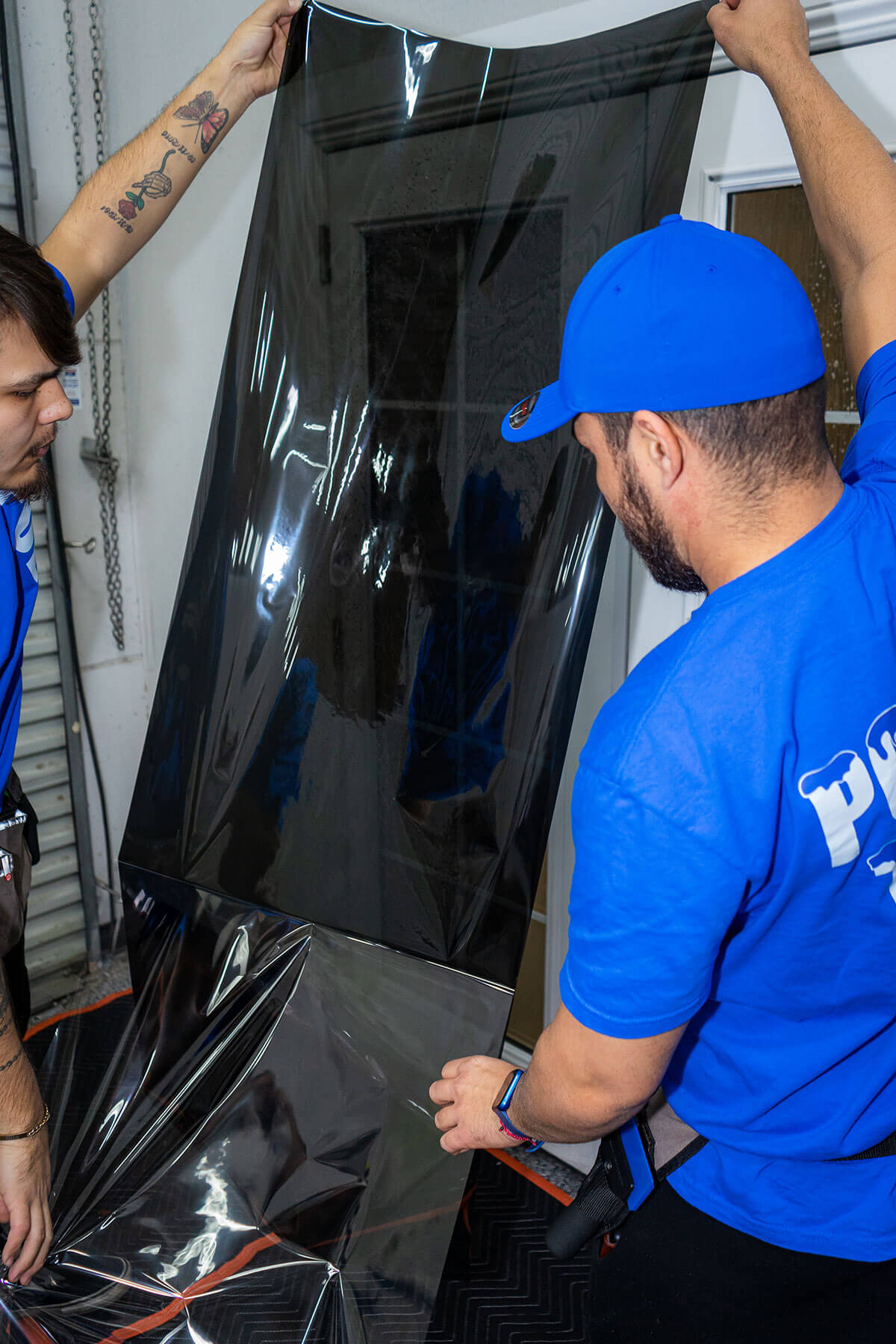
Decorative privacy film covers the same job as frosted film — blocking the view — but adds a gradient band, a custom logo, or a repeating pattern instead of a flat frost. It's the standard tool for conference-room glass partitions, executive-office privacy bands, and lobby branding in open-plan and multi-tenant buildings, where the film needs to look intentional, not just functional.
For tenant-improvement work, decorative film is the practical choice: it installs on existing glass, meets landlord appearance standards, and strips off cleanly at lease-end. For owner-occupied homes and buildings, it delivers a designed look without the cost or lead time of custom etched glass.
The four film types above install the same way whether the glass is in a house or an office — but the typical use case, the visit, and the surrounding project differ.
| Aspect | Residential privacy film | Commercial privacy film |
|---|---|---|
| Typical glass | Bathrooms, bedrooms, entry sidelights, picture windows, sliding doors | Conference-room partitions, storefront glass, lobby walls, executive offices |
| Most-used type | Frosted and one-way mirror | Decorative/branded and frosted bands |
| Quote visit | Free in-home consult | Free on-site survey, after-hours scheduling available |
| Common driver | Street-facing exposure, bathroom/bedroom coverage | Tenant-improvement lease terms, brand identity, client-facing privacy |
| Removability priority | Optional — homeowner's choice | Usually required — landlord/lease-end condition |
| Warranty | Polar Tint Promise | Polar Tint Promise |
See the full residential window film lineup or the full commercial window film lineup for heat-rejection and security film alongside these privacy options.
Privacy window film and automotive window tint are related products — both are polymer films applied to glass — but they answer to different rules. A vehicle's windows are covered by state vehicle-equipment law: every state sets a minimum VLT (visible light transmission) percentage for front side windows because a driver's outward visibility is a traffic-safety issue, and installers have to work within those limits. Our automotive window tint page and window tint laws by state guide cover those numbers state by state.
Stationary building glass — a house window, a storefront pane, a conference-room partition — isn't covered by those vehicle VLT statutes, which is why privacy film can go fully frosted, fully one-way, or fully patterned in ways a car's front windows legally can't. The only outside constraints that typically apply to residential or commercial privacy film are a homeowners association's appearance rules or a commercial lease's landlord standards — not a state VLT floor. See our HOA-approved window film guide for what most residential communities check.
Bathrooms, bedrooms, shower glass, and entry doors need coverage that doesn't depend on the sun being up — choose frosted or etched-look film.
Street-facing living rooms and ground-floor offices used mainly in daylight are the classic fit for one-way mirror film.
Floor-to-ceiling picture windows and storefront glass that need to stay open and bright inside call for perforated film.
Conference rooms, lobbies, and brand-facing glass usually go decorative or branded — privacy that reads as a design choice.
Not sure which fits? A Polar Tint installer walks every window with you at the free consult and recommends the right type per pane — most homes and offices end up with more than one.
Find your nearest Polar Tint location and book a no-obligation visit. Frosted, one-way mirror, perforated, and decorative privacy film all quoted on the same visit.